Reading Shallow Flood Depth from Real USGS Gauge-Camera Footage with a Learned Staff-Plate Reader
Abstract
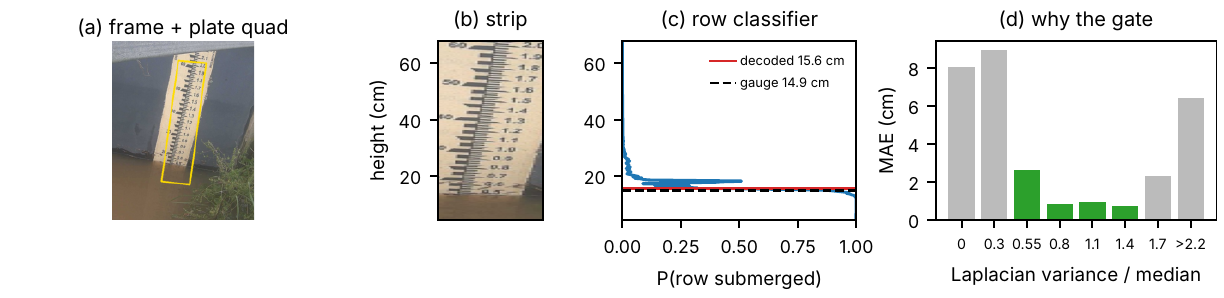
How accurately can a fixed camera estimate flood water depth, and how well does that transfer across cameras? I use real USGS staff-plate cameras whose official gauge heights serve as labels. A learned reader registers each frame, rectifies the plate, classifies plate rows as submerged and decodes the water level. An image-quality gate abstains on bad frames.
On the main shallow-flow camera (2259 frames, 15 months), leaving out whole months gives 1.13 cm mean absolute error on the 67% of frames passing the gate (6.97 cm for a colour-threshold baseline), and 0.79 cm on two locked months. Error stays below twice its native value up to 5.0 cm per pixel.
Applied unchanged to three cameras downloaded afterwards, with each camera held out of training in turn, the reader beats a no-water guess on two cameras and fails on one. A river camera is read to 12 cm over a 211 cm flood.
Headline numbers
Mean absolute error in cm on frames that pass the quality gate. Every value on this page is generated from the files in results/ (see Reproduce).
| Evaluation | Frames | Learned reader | Colour-threshold baseline | Always 0 cm |
|---|---|---|---|---|
| Leave-one-month-out CV (13 months) | 1319 | 1.13 [0.67, 1.69] | 6.97 | 8.8 |
| Locked test months (2025-04, 2026-04) | 233 | 0.79 | 11.52 | 18.9 |
Brackets are 95% intervals from a bootstrap over whole months. The two locked months are too few to give an interval. The gate drops 33% of CV frames and 18% of locked frames; without it the errors are 3.38 cm (CV) and 3.11 cm (locked). See Results for the full breakdown.
Where to go next
| Method | Registration, plate rectification, the row classifier, the decode step and the error model |
| Data | The USGS cameras, where the gauge labels come from, and how the splits keep months apart |
| Results | Held-out and locked-test errors, resolution sweep, other cameras, failure gallery |
| Demo | Step through a real flood event frame by frame, in your browser |
| Paper | The four-page PDF and a BibTeX entry |
| Reproduce | Setup, make targets, and which script produces which result |
| Limitations | What these results do and do not show |