Method
- The question
- 1. Register the frame
- 2. Rectify the plate
- 3. Classify each row
- 4. Decode the water level
- 5. Quality gate
- Baselines
- Error model
- Cross-camera protocol
The question
Given one frame from a fixed camera that sees a reference object of known scale, estimate the water depth \(h\) (cm) at the object. Any flood response (a severity class, a warning level) is a function of \(h\), so the target is \(h\) itself, and error is reported by depth range.
One row of data is one frame. Prediction uses the current frame, a one-time setup (reference views and plate geometry) and, for pose recovery only, earlier frames. The gauge is never used at prediction time.
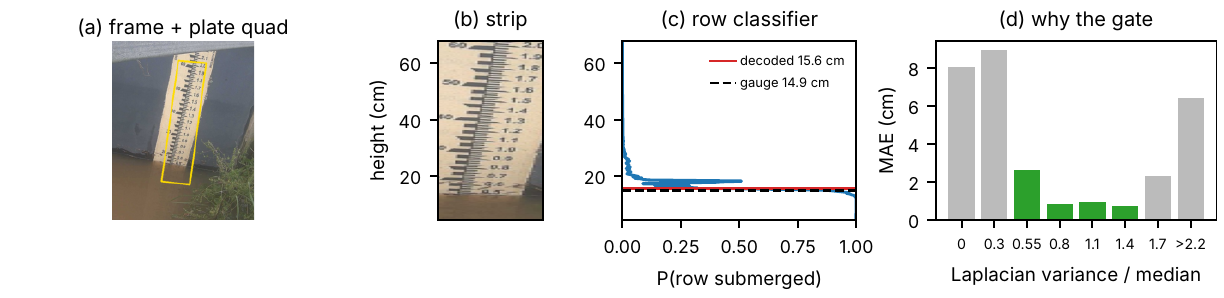
1. Register the frame
The camera pose changes between months, so the plate is not at a fixed pixel position. Each frame is matched with SIFT keypoints (after contrast equalisation, which helps infrared and washed-out frames) against a set of reference views of the same camera, and a homography to the main reference is fitted with RANSAC. Registration succeeds on 82% of frames. When it fails, the reader reuses the last good pose from an earlier frame (causal, never a later one); 18% of frames use a borrowed pose. The reference views come from development months and use geometry only, not labels.
2. Rectify the plate
The staff plate is a flat rectangle, so its outline in the reference view maps to an axis-aligned strip by a homography. Every frame is resized to 1280 px wide and the plate is resampled to a 360 × 48 pixel strip, which is about 0.16 cm per row. Row 0 is the top of the plate, and rows are linear in height.
3. Classify each row
For frame \(i\) and strip row \(k\) (height \(h_k\)), a gradient-boosted classifier (scikit-learn) outputs
\[p_{ik} = P(\text{row } k \text{ is submerged})\]from row colour, change against a dry template, texture, context from neighbouring rows and frame-level quality. The labels need no hand annotation:
\[y_{ik} = \mathbf{1}[h_k < g_i]\]where \(g_i\) is the official gauge height at the time of frame \(i\).
4. Decode the water level
Water is below some boundary and air above it, so the level is the single monotone change point that best explains the row probabilities:
\[b^\star = \arg\max_b \; \sum_{k<b} \log(1 - p_{ik}) + \sum_{k \ge b} \log p_{ik}\]The boundary is mapped to a height, then to centimetres by a least-squares affine fit on training frames. Levels at or below the plate bottom (4.3 cm) are reported as 0, because water below the plate cannot be seen. The log-likelihood gap to the runner-up boundary is kept as a confidence score, the margin.
5. Quality gate
A frame is rejected when its Laplacian variance (a sharpness measure) falls outside \([0.55, 1.7]\) times the training median. A low value means fog, blur or darkness. A high value means dirt on the lens or glare. Rejected frames get no reading; they are logged and the reader abstains.
The gate was chosen from development-month errors only. It started one-sided and became two-sided after the dev errors showed that dirty-lens frames also fail; that change is part of the locked-test disclosure on the Limitations page.
Baselines
- B0, always 0 cm. The trivial guess of no water.
- B1, colour threshold. A row counts as wet if its colour change from the dry template exceeds a threshold \(\tau\) tuned on training months, followed by the same decode and calibration.
Error model
Depth error should come from how well the waterline can be located in pixels, scaled by how many centimetres one pixel spans, plus a floor from the gauge-to-plate offset and calibration. With scale \(s\) (cm per pixel) and waterline error \(\sigma_v\) (pixels):
\[\mathrm{Var}(\hat h) = s^2 \sigma_v^2 + \sigma_g^2\]Fitting RMSE² to the resolution sweep gives \(\sigma_v = 0.55\) px and \(\sigma_g = 3.0\) cm. The floor dominates at fine scales, so at this camera’s native resolution the binding constraint is the gauge-to-plate reference, not pixels. The Results page shows the sweep, and the demo lets you coarsen a strip yourself.
Cross-camera protocol
For each target camera the classifier is trained on the other cameras only, with labels from their nominal plate geometry. The target’s dry template and gate thresholds come from its earliest month. Zero-shot uses the nominal geometry. Calibrated fits an affine map on that first month, and later months are evaluated. For the river camera (Hancock), one level offset is fitted from 30 development frames, and a pooled variant adds those frames to training.