Results
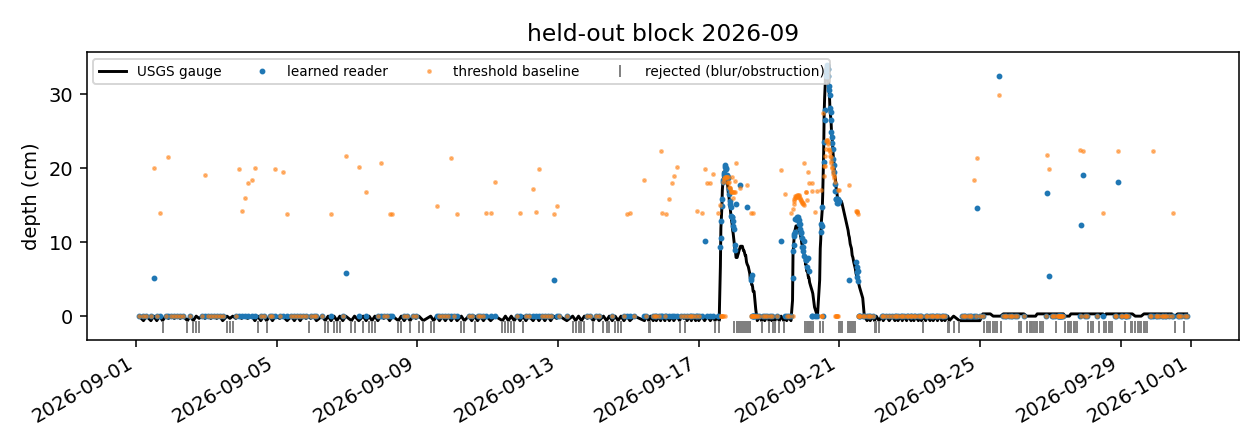
All numbers on this page are rendered from results/real/ by scripts/build_site_assets.py. Errors are in cm. Depth ranges are by gauge height: dry (up to 0.5 cm), 0.5–10 cm and above 10 cm.
Main result
Mean absolute error (MAE) is the primary metric. Intervals are 95% bootstrap intervals over whole months, so they reflect month-to-month spread rather than frame count. The two locked months give no interval.
| Evaluation | Frames | Method | n | MAE [95% CI] | RMSE | Bias | Dry | 0.5–10 | >10 |
|---|---|---|---|---|---|---|---|---|---|
| Leave-one-month-out CV | gated | learned reader | 1319 | 1.13 [0.7, 1.7] | 3.1 | +0.4 | 0.4 | 2.0 | 1.5 |
| gated | threshold baseline | 1319 | 6.97 [6.0, 8.4] | 10.1 | +1.1 | 5.9 | 8.0 | 7.8 | |
| all | learned reader | 1976 | 3.38 [2.1, 4.5] | 7.3 | +0.5 | 1.9 | 5.0 | 4.1 | |
| Locked test | gated | learned reader | 233 | 0.79 | 1.2 | +0.0 | 0.0 | 1.6 | 0.6 |
| gated | threshold baseline | 233 | 11.52 | 14.6 | -8.7 | 9.2 | 7.2 | 12.5 | |
| all | learned reader | 283 | 3.11 | 8.9 | -2.1 | 1.6 | 2.1 | 3.4 |
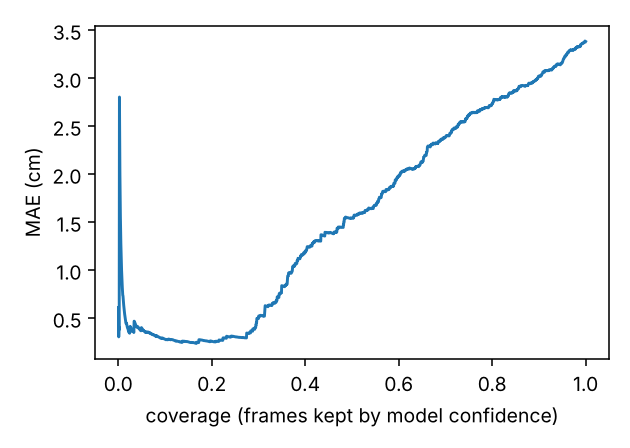
Gated means the frame passed the sharpness gate (coverage 67% in CV, 82% locked).
- On gated CV frames the learned reader has 1.13 cm MAE (95% CI 0.67–1.69) against 6.97 cm for the threshold baseline and 8.80 cm for always-0.
- On the two locked months it reaches 0.79 cm (baseline 11.52, always-0 18.90).
- Without the gate the errors are 3.38 cm (CV) and 3.11 cm (locked). The gate buys reliability by abstaining on 33% of CV and 18% of locked frames.
- Per-month MAE has median 1.06 cm and worst 3.78 cm.
- A causal five-reading median makes things worse (1.13 to 1.77 cm), because levels move tens of centimetres per hour.
Error by month
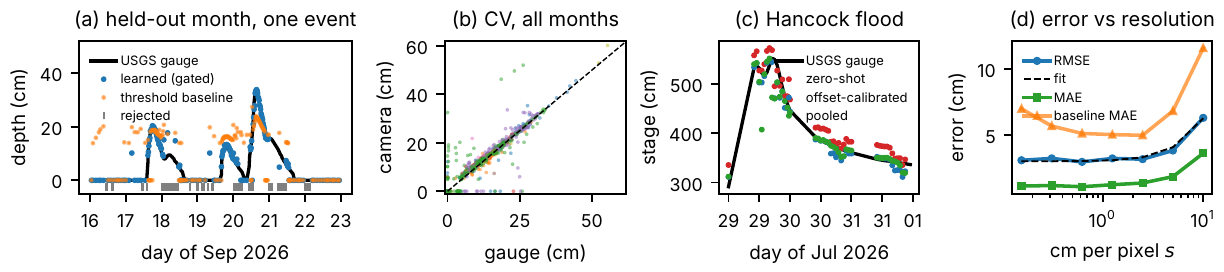
Gated MAE for each held-out month (leave-one-month-out CV). Bars are scaled to the largest month.
| Month | Frames | Largest gauge (cm) | MAE (cm) | |
|---|---|---|---|---|
| 2023-02 | 107 | 44.5 | 1.46 | |
| 2023-03 | 122 | 29.0 | 0.98 | |
| 2024-01 | 98 | 26.5 | 2.93 | |
| 2024-03 | 41 | 22.9 | 1.46 | |
| 2024-04 | 182 | 31.4 | 1.83 | |
| 2024-12 | 23 | 16.5 | 0.97 | |
| 2025-01 | 6 | 15.5 | 3.78 | |
| 2025-06 | 40 | 29.0 | 0.78 | |
| 2025-07 | 10 | 55.5 | 1.16 | |
| 2026-03 | 2 | -0.0 | 0.0 | |
| 2026-07 | 170 | 0.0 | 0.18 | |
| 2026-08 | 142 | 16.8 | 0.15 | |
| 2026-09 | 376 | 33.8 | 1.06 |
Resolution sweep
Registration is computed once at native resolution. Frames are then area-downsampled by a factor \(f\) from 1 to 64, the plate is resampled with 360/\(f\) rows, and the reader is retrained for each \(f\). Plate scale is \(s = 0.16 f\) cm per pixel.
| Downsample f | cm per pixel | Learned MAE | Learned RMSE | Baseline MAE |
|---|---|---|---|---|
| 1 | 0.16 | 1.13 | 3.08 | 6.97 |
| 2 | 0.31 | 1.17 | 3.22 | 5.66 |
| 4 | 0.62 | 1.08 | 2.96 | 5.11 |
| 8 | 1.25 | 1.23 | 3.22 | 5.02 |
| 16 | 2.49 | 1.36 | 3.16 | 4.97 |
| 32 | 4.98 | 1.84 | 3.82 | 6.81 |
| 64 | 9.96 | 3.61 | 6.28 | 11.55 |
Gated MAE is 1.13 cm at native scale, 1.36 cm at 2.5 cm/px, 1.84 cm at 5.0 cm/px and 3.61 cm at 10.0 cm/px, which is over twice native. With scale \(s\) and waterline error \(\sigma_v\), \(\mathrm{Var}(\hat h) = s^2\sigma_v^2 + \sigma_g^2\). Fitting RMSE² to the gated sweep gives \(\sigma_v = 0.55\) px and \(\sigma_g = 3.0\) cm. The \(\sigma_g\) floor dominates at fine scales, so resolution is not the binding constraint at this camera.
You can see what coarser scales do to the plate in the demo.
Ranking frames by decode margin instead of the sharpness gate gives 2.28 cm at the gate’s coverage (the gate gives 1.13 cm), so a cheap image statistic abstains better than the classifier’s own confidence.
Other cameras
Table values are gated MAE in cm. “/ 0” is the no-water guess on the same frames. The three added cameras and the river camera were not used to build the method.
| Camera | Scene | Largest gauge | In-site / 0 | Held-out zero-shot / 0 | Held-out calibrated | Gate coverage (held-out, %) |
|---|---|---|---|---|---|---|
in_overland | cream plate | 55 | 1.13 / 8.80 | 6.69 / 11.16 | 7.14 | 47 |
in_north | cream plate | 25 | 1.05 / 1.44 | 1.08 / 1.50 | 1.08 | 53 |
oh_wetland | white plate | 42 | 0.54 / 2.73 | 1.52 / 2.01 | 1.81 | 99 |
wi_mt1 | orange plate | 19 | 0.55 / 0.27 | 4.96 / 0.33 | 4.96 | 86 |
hancock | river plate | 211† | – | 20 / 86 | 12 | – |
† Hancock: the flood range above the plate bottom. Its trivial guess is the plate bottom.
- In-site (leave-one-month-out), the reader beats always-0 on
in_overland,in_north(1.05 vs 1.44 cm) andoh_wetland(0.54 vs 2.73 cm).wi_mt1stays nearly dry (gauge up to 19 cm), and always-0 wins there. - With the camera held out, zero-shot, the reader beats always-0 on
in_overland(6.69 vs 11.16 cm, but only 47% of frames pass the gate),in_north(1.08 vs 1.50) andoh_wetland(1.52 vs 2.01). - It fails on
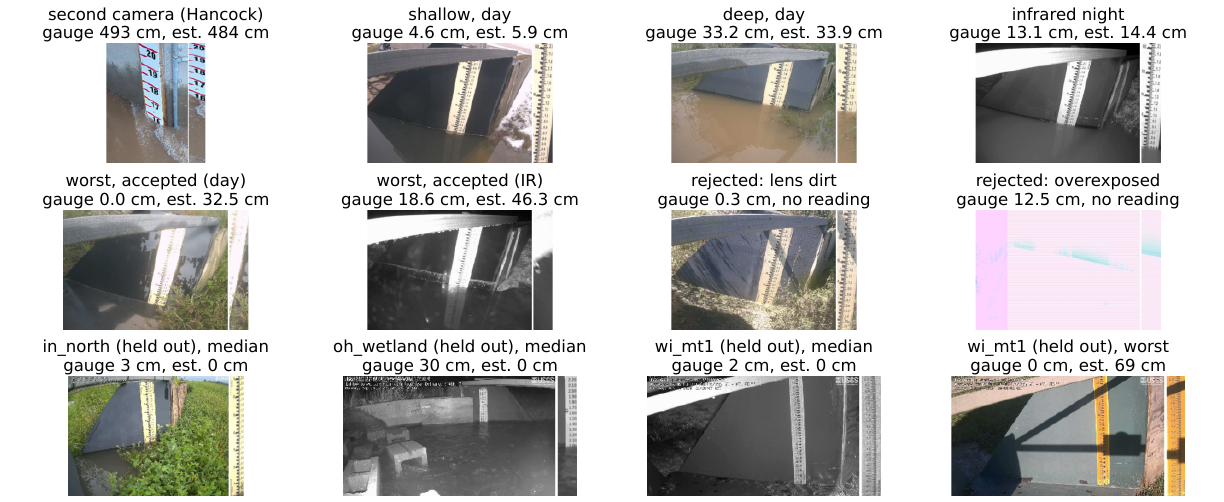
wi_mt1(4.96 vs 0.33). Having never seen an orange plate, the classifier reads it as fully submerged in sunny frames (69 cm at gauge 0). - On frames with water (gauge above 0.5 cm) its error is much larger (6.1 and 24.7 cm against 13.3 and 34.1 cm for the no-water guess), and calibration does not help.
- River plate. Zero-shot MAE over the 211 cm flood is 20 cm (plate-bottom guess 86), and 12 cm calibrated. Pooling helps inside the stage range it saw (4, 7 against 8, 11 cm at 11–16 ft) and hurts beyond it (37 against 22 cm at 16–19 ft).
wi_mt1 failure.Failure audit
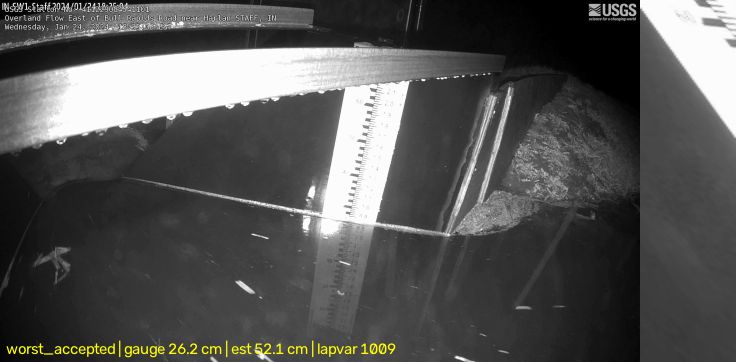
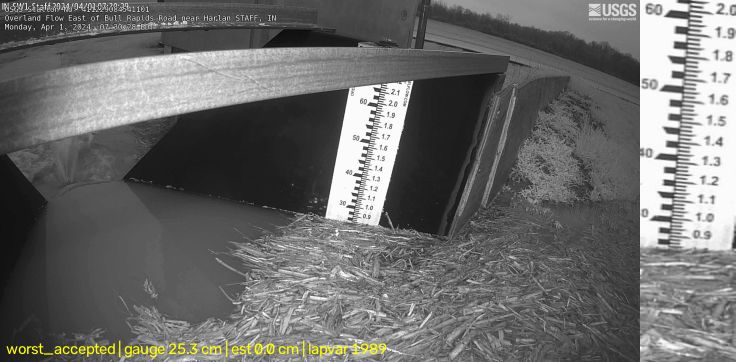
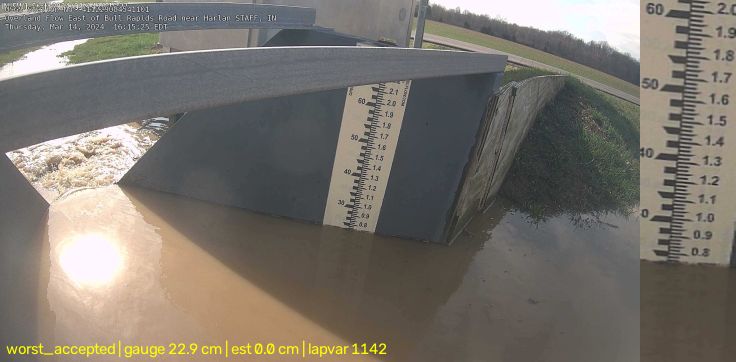
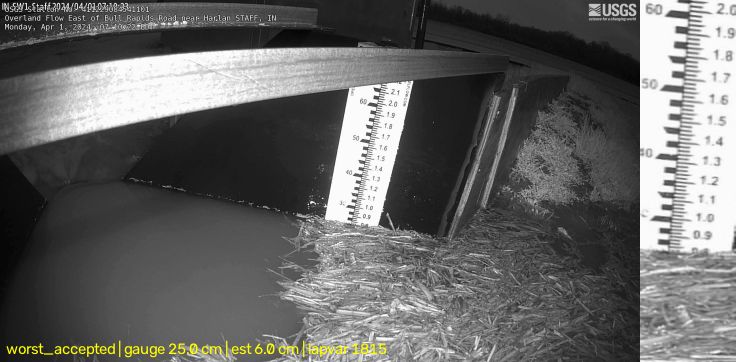
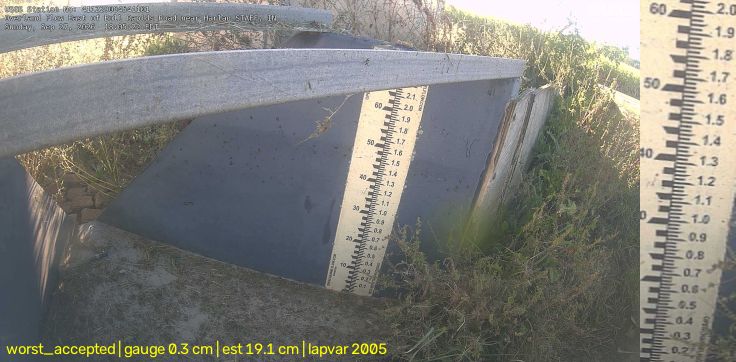
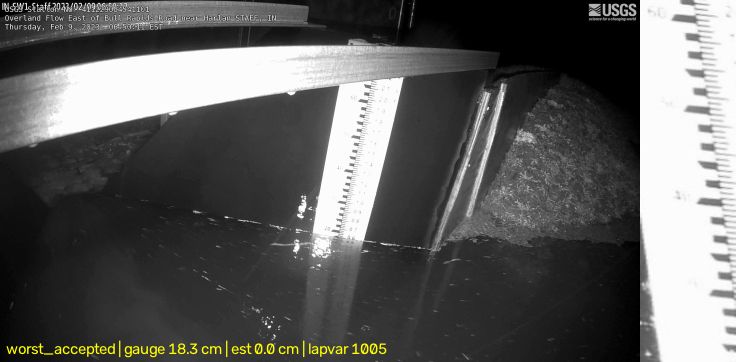
Infrared is not worse than daylight (3.30 vs 3.41 cm MAE). The costly cases are a borrowed pose (9.82 vs 1.91 cm for a registered pose) and frames outside the gate (7.90 vs 1.13 cm). In the worst accepted day frame, glare washes out the plate and water streaks on the panel look like wet rows.
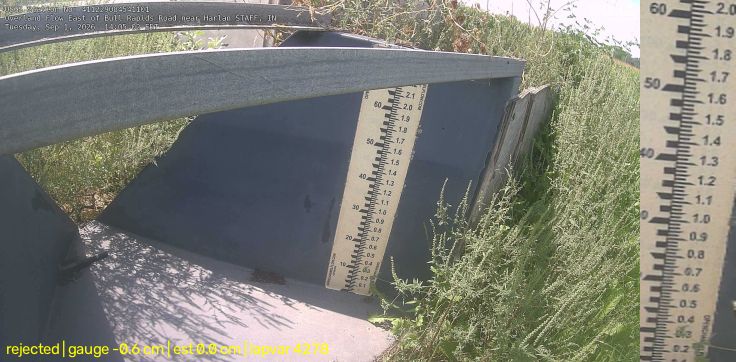
The overlays below are saved by scripts/real_report.py. Each shows the frame, the plate strip and the reading. Captions give the gauge height and the reader’s estimate.
Worst accepted frames
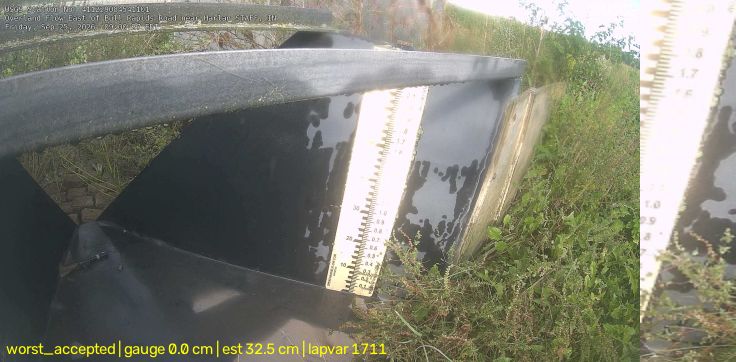
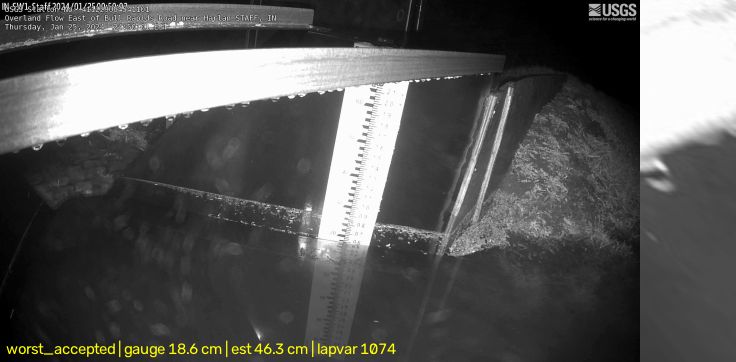
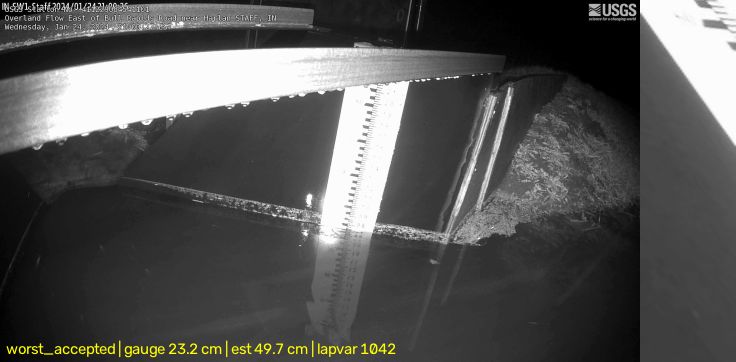
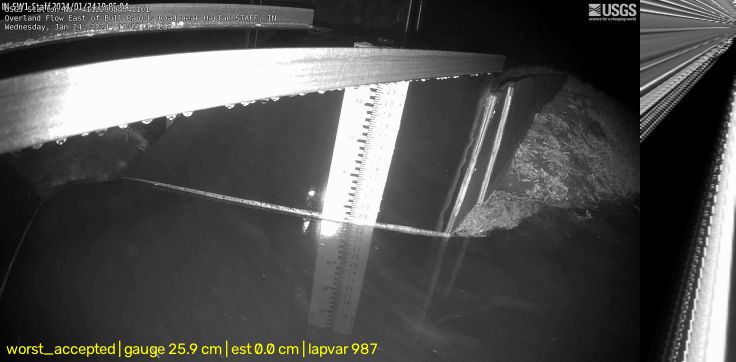
Rejected frames
More figures